TRACE: Interactive Bi-Directional Cable Tracing Amid Clutter
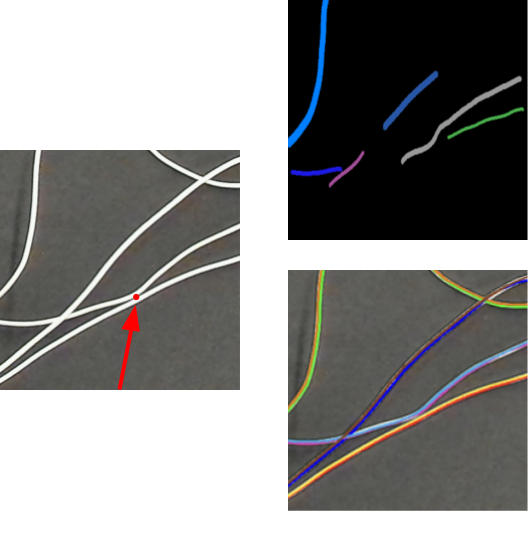
Two-way Routing and Cable Estimation
TRACE Concept Overview
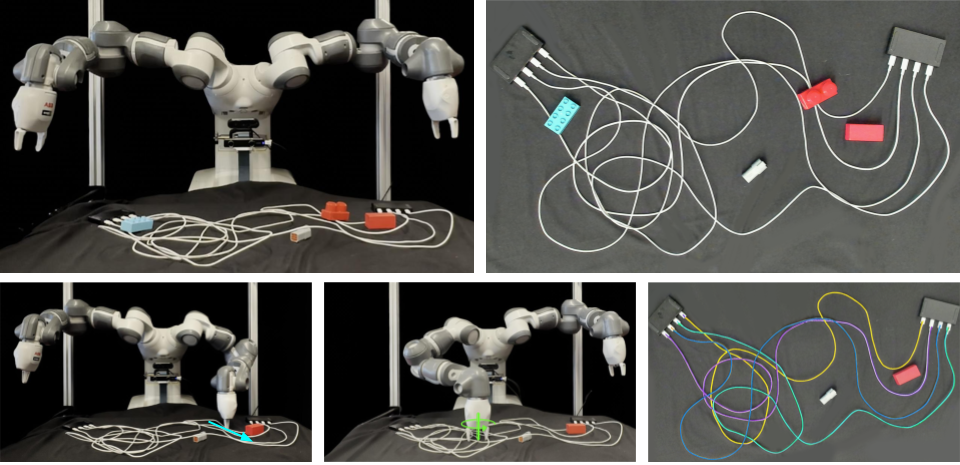
TRACE receives an overhead image as input (top right). By running a cable state estimator from each endpoint, TRACE identifies points of ambiguity, or divergence points, which are then disambiguated by targeted interactive perception primitives (bottom left and middle).
TRACE Framework
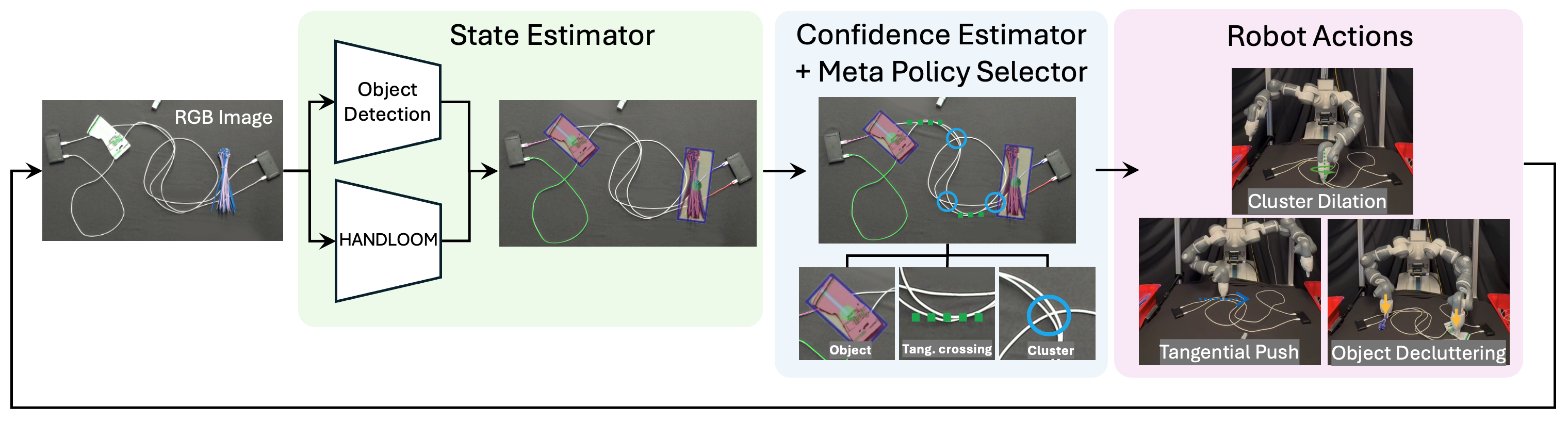
TRACE runs the cable state estimator bi-directionally, identifies divergence points, and disambiguates with interactive perception primitives continuously until the cables are successfully traced.
Divergence Point Detection
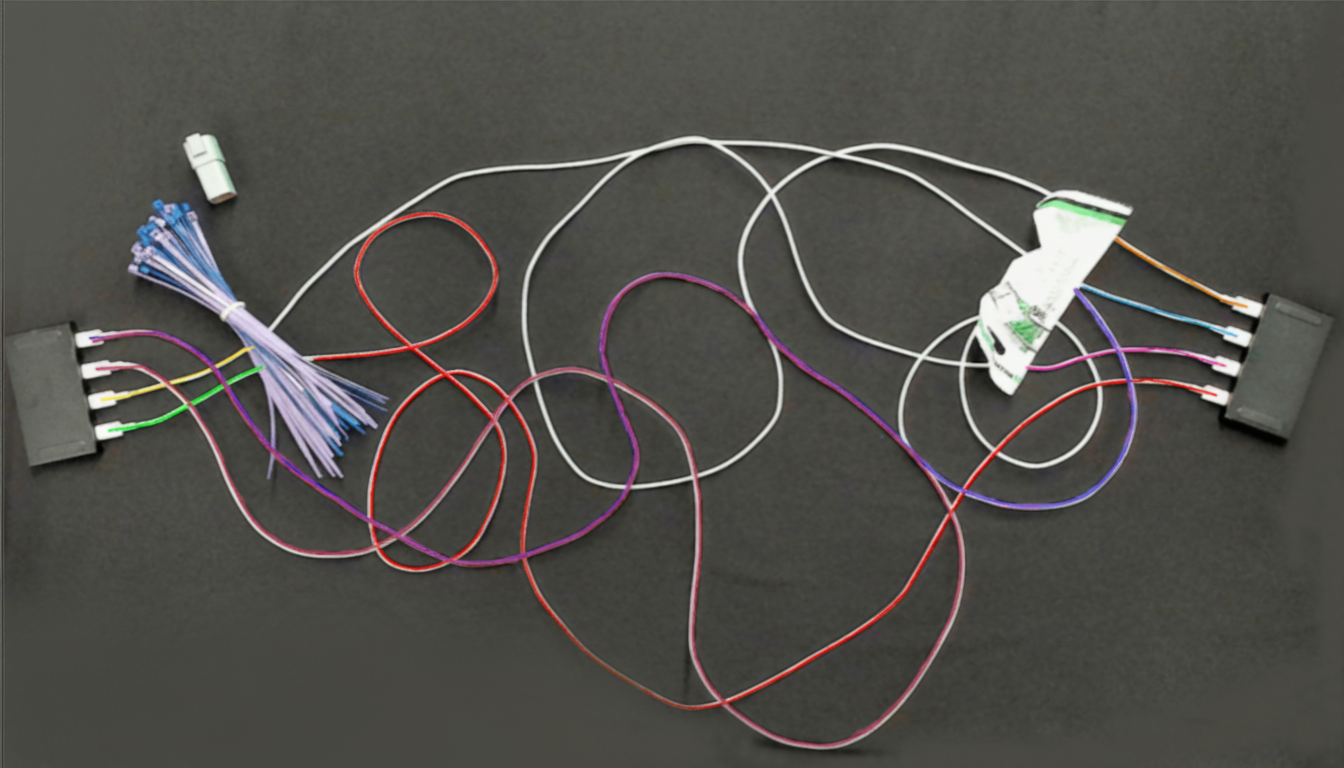
TRACE first initiates traces from each endpoint, resulting in two separate traces per cable.
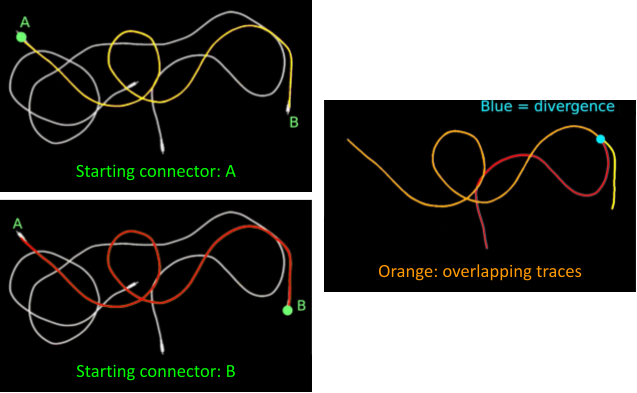
Candidate trace pairs, or the forward and backward traces of a single cable, are determined by matching traces with high overlap. Points where the cables no longer overlap are marked as divergence points—locations where interactive perception primitives will be applied.
Interactive Perception (IP) Moves
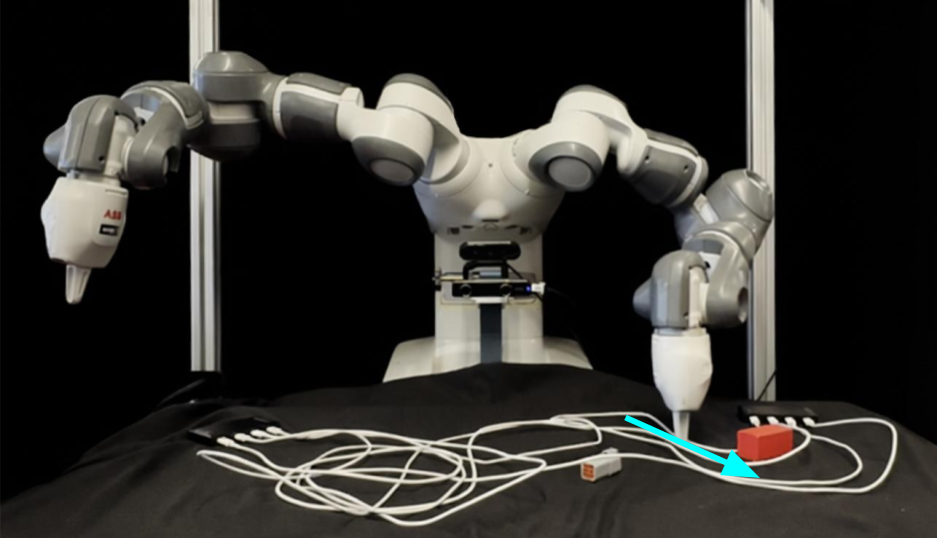
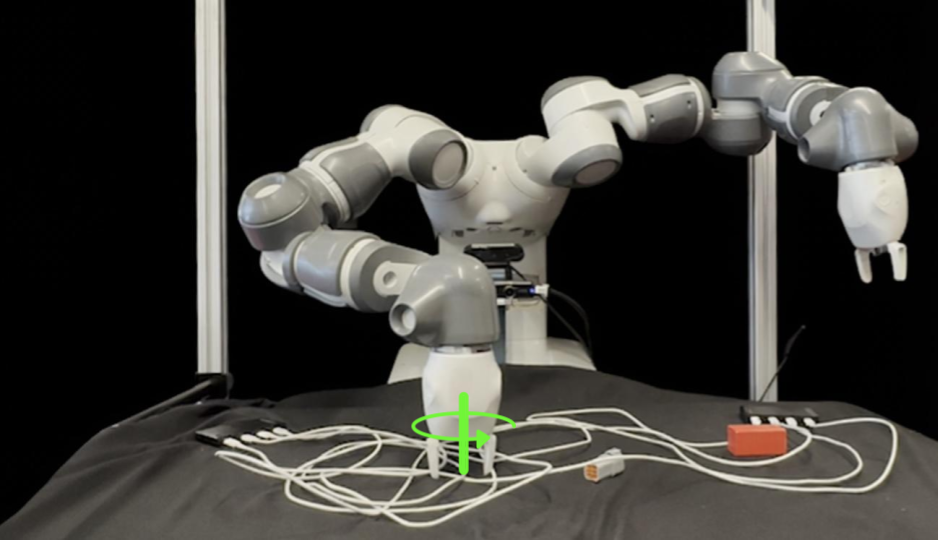
Interactive perception primitives are selected based on the cable density in a local region at the divergence point. TRACE applies a Divergence Push in regions with low density and a Cluster Dilation in highly dense regions.
Results
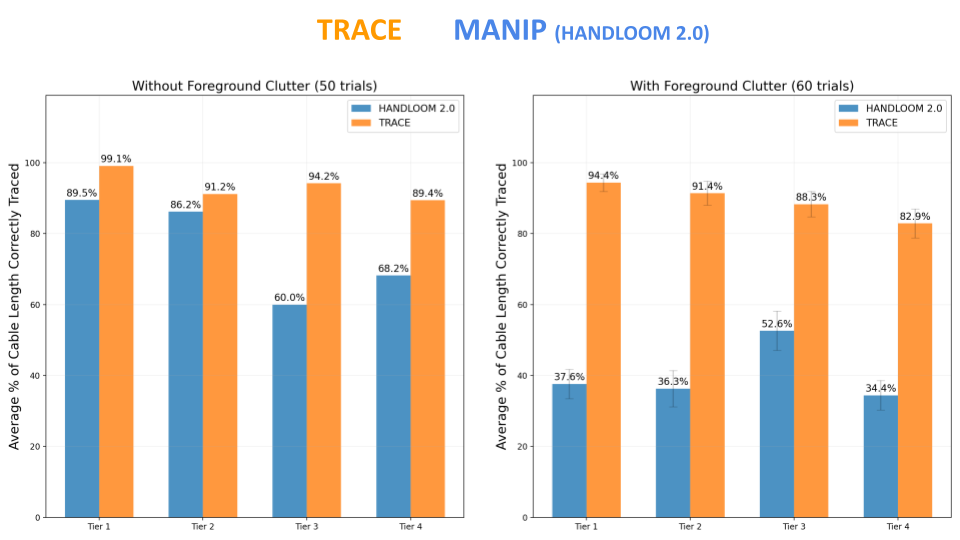
We baseline TRACE against HANDLOOM 2.0 from MANIP in 110 physical experiments. TRACE consistently outperforms HANDLOOM 2.0 in scenarios with foreground clutter and without foreground clutter across all tiers of difficulty.
We also baseline TRACE against RT-DLO on small image crops, since RT-DLO only traces small portions of full images. To isolate TRACE’s interactive perception primitives, we compare the trace accuracy on the initial and final image of each trial. While RT-DLO’s performance increases after TRACE’s interactive primitives, TRACE achieves higher accuracy.